SINDHI
The Sindhi breed originated in the Sindh province of present-day Pakistan. Due to their hardiness, heat resistance, and high milk yields, Sindhi cattle have spread beyond South Asia to at least 33 countries across Asia, Africa, Oceania, and the Americas.
Alternative Names
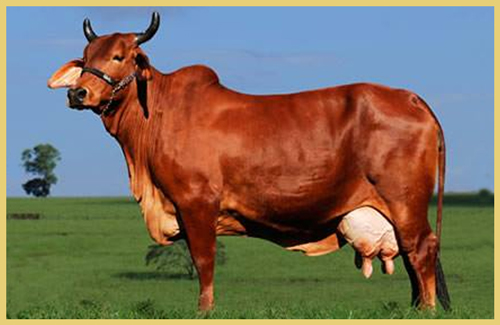
This breed is also known by several regional names, including Malir (Baluchistan), Red Karachi, and simply Sindhi.
Milk Production
Sindhi cows are prolific milk producers, making them a valuable dairy breed in tropical and subtropical climates.
- Under standard management conditions, Sindhi cows average over 1,700 kg (3,750 lbs) of milk per lactation after suckling their calves.
- Under optimum conditions, milk yields can exceed 3,400 kg (7,500 lbs) per lactation, with some elite cows producing even more.
- The milk has a high butterfat content, making it desirable for dairy farmers.
Physical Characteristics
- Size & Weight:
- Cows: Average height of 116 cm (45.7 in) and body weight of 340 kg (750 lbs).
- Bulls: Larger, standing at 134 cm (52.7 in) with an average weight of 420 kg (925 lbs).
- Color:
- The most common color is a deep, rich red, but shades range from yellowish-brown to dark brown.
- Bulls tend to be darker than cows, sometimes appearing almost black on the extremities (head, feet, and tail).
- Horns:
- Short, curved horns, distinguishing them from the Tharparkar (White Sindhi) breed, which has longer, lyre-shaped horns.
Comparison with Other Breeds
- Sindhi cattle are smaller and rounder than the Tharparkar breed, which is taller and more typical of Zebu draft breeds.
- Compared to the Sahiwal breed, Sindhi are slightly smaller and produce slightly less milk, though they remain highly valued in crossbreeding programs.
Uses & Adaptability
- Sindhi cattle are primarily used as a dairy breed, but they also contribute to beef and dual-purpose breeding programs.
- Their high milk yield results in fast-growing calves, making them ideal for crossbreeding with beef breeds to produce efficient, early-maturing calves.
- While Sindhi cattle were once widely favored in India and Pakistan, some commercial dairies have phased them out in favor of the higher-yielding Sahiwal breed. Crossbreeding programs have resulted in Sahiwal-dominant hybrids, where three-quarter Sahiwal, one-quarter Red Sindhi cattle are visually indistinguishable from pure Sahiwal.
- Sindhi cattle have also been introduced to Brazil, where they are used for milk production, though they are not as popular as other Zebu breeds like Nelore or Guzerat.
The Sindhi remains one of the most widely distributed dairy Zebu breeds due to its adaptability to hot climates, disease resistance, and productive milk yield. While it has lost some favor in South Asia to the Sahiwal breed, its genetic influence continues to shape crossbreeding programs worldwide, particularly in tropical regions.
Click an image below
for information on other
Bos Indicus breeds